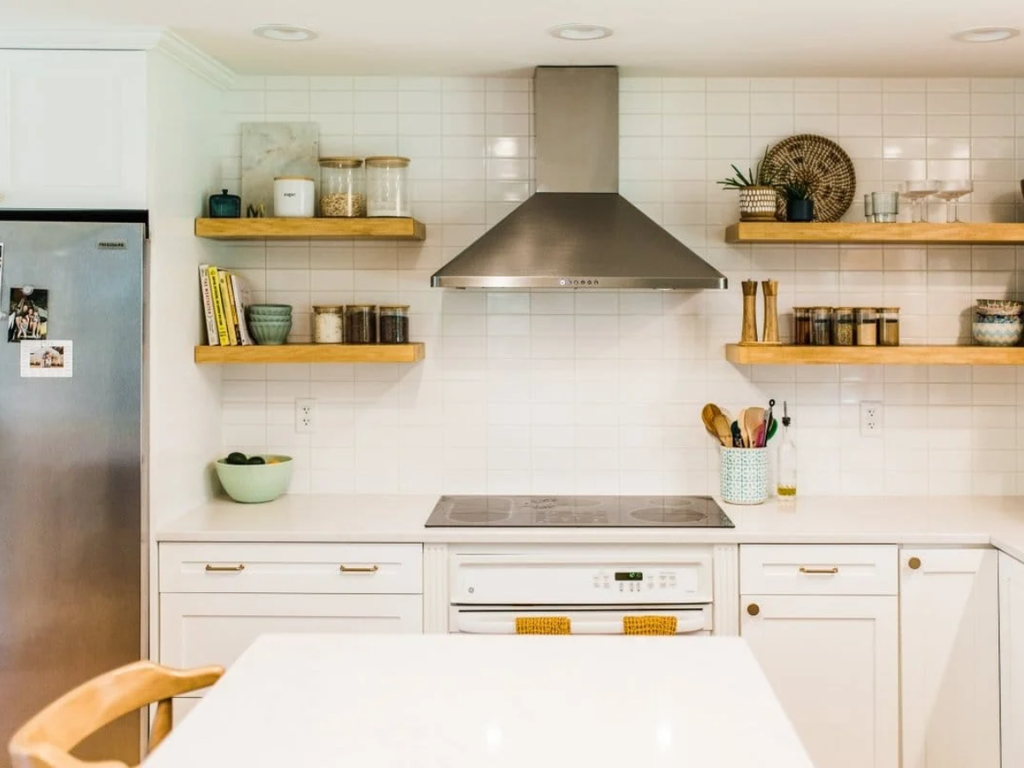
Small kitchens need effective ventilation just as much as larger cooking spaces, but limited wall and cabinet dimensions can make selecting the right hood more challenging. Apartments, condos, accessory dwelling units, studio kitchens, and compact remodels often use narrower cooktops where a full-size hood would overwhelm the available space. In these situations, a kitchen hood 24 inches wide can provide a practical balance between cooking-surface coverage and efficient use of space. Width alone, however, does not determine ventilation performance. Airflow, duct design, mounting height, filter type, noise, and whether the hood exhausts outdoors all influence how effectively cooking smoke, grease, moisture, odors, and airborne particles are removed.
Why 24-Inch Range Hoods Work Well in Small Kitchens
A 24-inch hood is generally suited to a similarly sized cooking surface, making it useful in kitchens where cabinet space and wall width are limited.
Common applications include:
- Small apartments
- Condominiums
- Studio kitchens
- Guest suites
- Basement kitchens
- Tiny homes
- Compact rental properties
- Secondary kitchens
The main advantage of a kitchen hood 24 inches wide is proportionality. It can fit above a compact cooktop without requiring major changes to surrounding cabinetry.
However, the hood should still adequately cover the cooking area. Smoke and grease that escape around the sides of the hood can spread into the room before the blower has an opportunity to capture them.
When possible, homeowners should compare the actual cooking-surface width with the hood dimensions instead of selecting a hood based only on available cabinet space.
Decide Between Ducted and Recirculating Ventilation
One of the most important decisions is whether the hood will exhaust air outdoors or recirculate filtered air back into the kitchen.
A ducted hood captures cooking contaminants and directs them outside through exhaust ducting. A recirculating system passes the air through filters before returning it indoors.
For indoor air quality, outdoor exhaust has an important advantage. The U.S. Environmental Protection Agency recommends using range hoods whenever cooking and says that venting the hood outdoors, when possible, can substantially reduce exposure to particulate matter created during cooking.
The EPA also specifically recommends exhaust ventilation over gas cooking appliances because a hood vented outdoors helps reduce exposure to combustion pollutants.
A recirculating kitchen hood 24 inches wide may still be useful where exterior ducting is impossible, but homeowners should understand that it does not remove cooking air from the home in the same way as a properly installed ducted system.
Choose Airflow Based on Cooking Habits
Hood airflow is commonly expressed in cubic feet per minute, or CFM. Higher CFM means the blower can theoretically move more air, but selecting the largest available number is not always the best strategy.
Airflow requirements depend on several factors:
- Cooking appliance type
- Number of burners
- Frequency of cooking
- High-heat cooking habits
- Hood mounting position
- Kitchen configuration
- Duct length and diameter
Someone who mostly boils pasta and reheats food has different ventilation demands from someone who regularly fries, sears, grills, or cooks several dishes simultaneously.
The EPA notes that a properly sized range hood should be used with gas ranges and references 100 CFM as a typical recommendation from ASHRAE and the Home Ventilating Institute for a typical kitchen range. Actual requirements can vary with the installation and appliance.
When selecting a kitchen hood 24 inches wide, airflow should therefore be matched to the cooking setup rather than chosen independently of it.
Keep the Exhaust Duct Efficient
A strong blower cannot compensate completely for poor duct design. Long or restrictive duct runs create resistance that can reduce actual airflow and increase operating noise.
Efficient duct planning generally favors:
- Shorter exhaust routes
- Smooth metal ductwork
- Fewer bends and elbows
- Correct duct diameter
- Properly sealed joints
- Direct discharge outdoors
Sharp turns and undersized ducts force the blower to work harder to move the same amount of air.
The manufacturer’s installation requirements should always be checked because the recommended duct diameter can vary according to the hood and blower design.
For renovation projects, planning the duct route before purchasing the hood can prevent situations where a suitable-looking appliance cannot be installed efficiently.
Check Mounting Height Before Installation
Mounting height influences both safety and capture performance.
If a hood is positioned too far above the cooktop, more smoke and steam may spread outward before reaching the capture area. If it is installed too close, it can interfere with cooking and may fail to meet required clearances.
There is no single mounting height suitable for every kitchen hood 24 inches wide. Installation requirements depend on the hood model, cooking appliance, fuel type, and applicable manufacturer instructions.
Both the range and hood installation manuals should be reviewed, and the greater required clearance should generally govern when their instructions differ.
This is particularly important above gas appliances because of the heat and open flame produced during operation.
Consider Makeup Air With High-Capacity Hoods
Powerful exhaust systems remove large volumes of indoor air, and that air must eventually be replaced.
The 2024 International Residential Code contains makeup-air requirements for certain kitchen exhaust systems capable of exceeding 400 CFM when specified fuel-burning appliances are located within the dwelling’s air barrier. Where the rule applies, replacement air must be supplied at approximately the same rate as the exhaust airflow.
Local building codes may adopt different editions or amendments, so homeowners should verify requirements with the relevant building authority or qualified HVAC professional.
This consideration can be especially important in newer, tightly sealed homes where natural air leakage is limited.
Look at Noise Alongside Maximum CFM
Noise can determine how frequently a range hood is actually used.
A system that is excessively loud at useful operating speeds may encourage occupants to switch it off prematurely. Noise levels can be influenced by blower design, fan speed, duct restrictions, installation quality, and airflow capacity.
For everyday cooking, a kitchen hood 24 inches wide that provides adequate capture at a comfortable noise level may be more practical than a higher-powered unit that residents avoid using.
The EPA recommends switching on an outdoor-vented range hood whenever cooking and leaving it operating for approximately 10 to 20 minutes afterward. It also recommends using back burners when practical because they can improve capture of cooking emissions.
Make Filter Maintenance Part of the Plan
Grease filters collect airborne cooking residue before it enters internal hood components and ductwork. Over time, accumulated grease can restrict airflow and reduce performance.
Cleaning frequency depends on how often and how heavily the kitchen is used. Frequent frying or high-heat cooking generally requires more regular cleaning than occasional light cooking.
The EPA specifically recommends routinely cleaning the range hood grease filter as part of improving indoor air quality while cooking.
Homeowners should check whether the filters are washable, dishwasher-safe, or designed for replacement. Recirculating models may also use additional filters that need periodic replacement.
Routine maintenance helps a kitchen hood 24 inches wide continue operating efficiently instead of gradually losing performance as residue accumulates.
Conclusion
A compact hood can provide effective ventilation when its dimensions, airflow, ductwork, mounting height, and filtration are matched to the cooking environment. Homeowners should prioritize actual capture performance and outdoor exhaust where practical instead of selecting ventilation equipment based only on appearance or maximum CFM. Those planning different kitchen layouts may also research How to Choose an Island Range Hood when the cooktop is positioned away from a wall and requires a different capture strategy. For smaller wall-based cooking areas, a properly selected kitchen hood 24 inches wide can provide space-efficient ventilation while helping control smoke, grease, moisture, odors, and airborne cooking pollutants.
