Ingrid Holm had been running a mid-sized freight forwarding company in Oslo for twelve years when she noticed that her largest clients were quietly beginning to ask questions she couldn’t answer quickly. How many hours until my shipment clears Oslo customs? Can I see the real-time temperature log for my pharmaceutical cargo? What is the current status of my booking against the original schedule? Her operations team could answer all of those questions, but it took them between 30 minutes and several hours to assemble the data from three systems that didn’t talk to each other, translate it into a format the client could understand, and communicate it through email. Her clients weren’t complaining loudly. They were beginning to mention, quietly and then less quietly, that a competitor had launched a client portal. Ingrid didn’t think of her company as a technology business. It was a freight forwarding business, and she had always sourced her operational software from vendors who specialized in logistics, paying licensing fees for systems that handled the industry-standard workflows reasonably well. The problem was that those standard workflows were no longer differentiating her. Every competitor of equivalent size was running the same vendor platform with the same feature set. When she brought in a Custom Software Development Company to build the client visibility portal her largest accounts had been asking about, the first conversation changed how she thought about the relationship between software and competitive advantage entirely. The vendor platform was infrastructure. The custom layer built on top of it was where her business could become genuinely distinctive from competitors who were running identical infrastructure. That distinction, between software as commodity and software as competitive asset, is the clearest way to understand what custom development actually buys a business that off-the-shelf alternatives cannot.
The Commodity Software Trap
The software that every competitor in an industry uses is the software that makes every competitor in that industry equivalent. ERP systems sold to the logistics sector standardize how freight is booked, tracked, and invoiced. CRM platforms sold to professional services standardize how client relationships are managed and how proposals are structured. Accounting software sold across categories standardizes how financial data is recorded and reported. All of that standardization is valuable, because it ensures that the operational foundation of the business follows proven practices that reduce the risk of process failures.
The problem emerges at the edge where standardized processes meet the specific ways a business has learned to create value for its particular customers. Ingrid’s freight forwarding company had developed a cold chain monitoring methodology that was genuinely superior to what her competitors offered for pharmaceutical shipments, built over years of working with a specialized client base. That methodology existed in the heads of her operations team and in a set of procedures they followed manually. The vendor platform she used had no mechanism for representing, automating, or making visible to clients the specific value she was delivering through that methodology. The competitive advantage was real and invisible.
Custom software development creates the mechanism for making invisible advantages visible and manual processes systematic. When Ingrid’s portal surfaced continuous temperature logs alongside shipment status for pharmaceutical clients, the advantage she had always had became something her clients could see and value explicitly rather than inferring from outcomes.
Where Custom Development Creates Durable Advantage
Competitive advantages created through custom software are more durable than those created through process improvements alone, because software embeds process in a form that is harder to replicate through observation. A competitor can watch how Ingrid’s team handles a pharmaceutical shipment inquiry and attempt to replicate the process manually. They cannot easily replicate the integrated system that makes that process scalable, consistent, and visible to the client without seeing the underlying code.
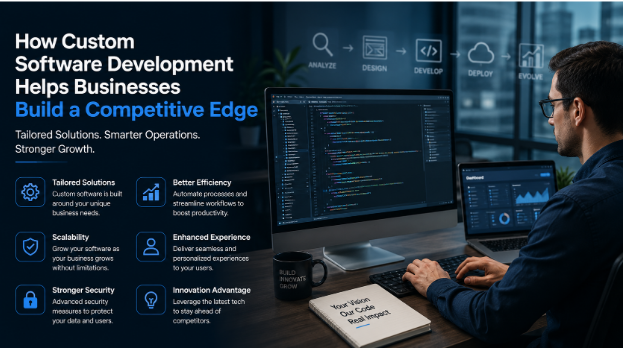
The categories of advantage that custom software creates most consistently are integration advantages, experience advantages, and data advantages. Integration advantages arise when a custom system connects sources of operational data that vendor platforms leave disconnected, creating a unified view of the business that enables decisions no individual system could support. Experience advantages arise when the interface a customer or employee uses to interact with the business is purpose-built for their specific needs rather than adapted from a generic design. Data advantages arise when custom systems capture and structure business-specific data that standard platforms don’t have fields for, creating an analytical asset that compounds over time.
Ingrid’s portal created all three categories. The integration of her customs broker’s data feed, her warehouse management system’s temperature logs, and her carrier’s tracking API into a single client-facing view was an integration advantage. The interface designed specifically for pharmaceutical procurement managers who needed to see compliance documentation alongside logistics status was an experience advantage. The historical temperature compliance data accumulated across three years of shipments, queryable by pharmaceutical product category and trade lane, was a data advantage her competitors couldn’t replicate without years of equivalent data collection.
Custom Software Development for Startups and Early-Stage Businesses
The conversation about custom software is often framed as relevant only to established businesses with existing operational systems and the budget to invest in bespoke technology. That framing misses a significant portion of the businesses for which custom development is most strategically important.
Custom software development for startups and early-stage businesses is often the mechanism through which the core product itself is built. A startup whose value proposition is a new way of doing something that existing software doesn’t support needs custom development not to enhance an existing capability but to create the capability that defines the business. The distinction between the product and the software is often artificial at this stage, because the product is the software.
Early-stage businesses that build on off-the-shelf platforms for the sake of development speed frequently discover that the constraints of those platforms shape the product in ways that compromise the original value proposition. A marketplace startup that builds on a generic e-commerce platform finds that the platform’s data model, pricing logic, and user flow assumptions are optimized for a different product category and require increasingly awkward customization to support the intended experience. The accumulated workarounds become technical debt that is eventually more expensive to resolve than a purpose-built system would have been from the start.
The decision framework for early-stage businesses is not whether to invest in custom development but which layer to customize and at what stage. Building custom where the differentiation lives, and using off-the-shelf where the business logic is commodity, is the capital-efficient approach that preserves development budget for the capabilities that matter most.
The Integration Layer as Competitive Infrastructure
For established businesses, the most impactful form of custom development is frequently not a new application but an integration layer that connects existing systems in ways their vendors never intended. The enterprise technology landscape of any mid-sized business is a collection of point solutions that each solve their intended problem well and communicate with adjacent systems poorly. A custom integration layer that makes those systems work together as a unified operational platform is often more valuable than replacing any individual system would be.
Ingrid’s business had a customs brokerage system, a warehouse management system, a freight booking platform, a carrier tracking aggregator, and a financial system for invoicing and accounts receivable. Each was the right tool for its function. None of them shared data with the others in real time. Her operations team bridged the gaps manually, which was the four-hour response time her clients were experiencing. The custom integration platform that connected those five systems cost a fraction of what replacing any of them would have cost and produced a visibility capability that none of them could have provided independently.
The integration layer created a second strategic asset beyond the client portal: internal operational visibility that Ingrid’s management team had never had before. The time from booking confirmation to customs clearance, the percentage of shipments with temperature exceptions by trade lane, the average delay at each stage of the freight journey by carrier, and the correlation between booking lead time and on-time delivery rates were all metrics her team could now track in real time rather than calculating retrospectively from data assembled across multiple systems. That operational intelligence changed how she managed capacity planning, carrier relationships, and the accounts she prioritized for proactive service attention.
Build vs Buy: Making the Decision Clearly
The build-vs-buy decision in software is genuinely context-dependent, and the framing that custom development is inherently better than off-the-shelf alternatives misrepresents a more nuanced trade-off. The relevant question is not whether to build or buy in the abstract but whether the specific capability being evaluated is a commodity function that standard software handles adequately or a differentiating function where the business’s specific approach creates value that generic software cannot represent.
Accounting is a commodity function for most businesses. The financial reporting requirements that apply to a freight forwarding company in Norway are similar enough to those of other businesses that a standard accounting platform handles them appropriately. Custom accounting software for Ingrid’s business would be an expensive way to replicate what SAP or Xero already does well.
Client-specific pharmaceutical shipment visibility with continuous temperature compliance documentation is not a commodity function. No standard platform serves that specific combination of requirements in the way Ingrid’s clients need it served. That is where custom development creates value that buying cannot, and where the investment in custom software is defensible precisely because it creates the differentiation that commodity software, by definition, cannot provide.
What Ingrid’s Business Looks Like Now
The pharmaceutical client that had first raised the visibility question signed a three-year contract extension six months after the portal launched. Two additional pharmaceutical accounts converted from competitors within eighteen months of the portal going live, both citing the compliance documentation capability as a differentiating factor. The four-hour response time that had been threatening her largest relationships became a real-time data feed that became a sales asset.
Ingrid still thinks of her company as a freight forwarding business. The software it runs is now both the foundation of its operations and the clearest expression of what makes those operations better than the competition. The distinction between the business and its technology has become harder to draw, which is exactly where the competitive advantage lives.
